Hello everyone!
This is the first devlog post about the first version of the game. Since I lost the previous website and its posts, I’m just going to summarize what every version was planning to be and what it featured when it was completed, and I’ll paste the changelog at the end of the post. The current writing date is December 10, 2025 (European date), but the post date will be relative to when the versions were posted, at least until I catch up with the recent posts.
Before this project, I had some Unity experience with the classic “big” projects started by a newbie, and obviously thrown away. Yes, I’m not a “start small” guy; I’m more of a “Start big, fail and trash everything every time, and learn something new every time.” I tried to do many games before that, some which I wish to develop in the future, others that I don’t have interest in anymore. I started coding with Unity in 2018, as a hobby, completely self-taught.
The project started around 2021: for a university course, I had to code a small game to pass the exam, and I thought: “I want to do a small game which I can publish on Steam, so I can kill two birds with one stone.” I coded a very basic survival in around 50 – 100 hours, which had the player model, a static island as a “world” that generated objects randomly above it, zombies that spawn at night, the campfire, a basic crafting system, some buildings (walls and spikes) to protect you, and nothing more. It was definitely an overworked project for a single exam – even the professors said that – but it did its job well. The inventory system was brought from a game which was brought from another game of mine started in 2018, and is continuously adapted for every project I did. It’s a bit of a Frankenstein of code, but it does its job well.
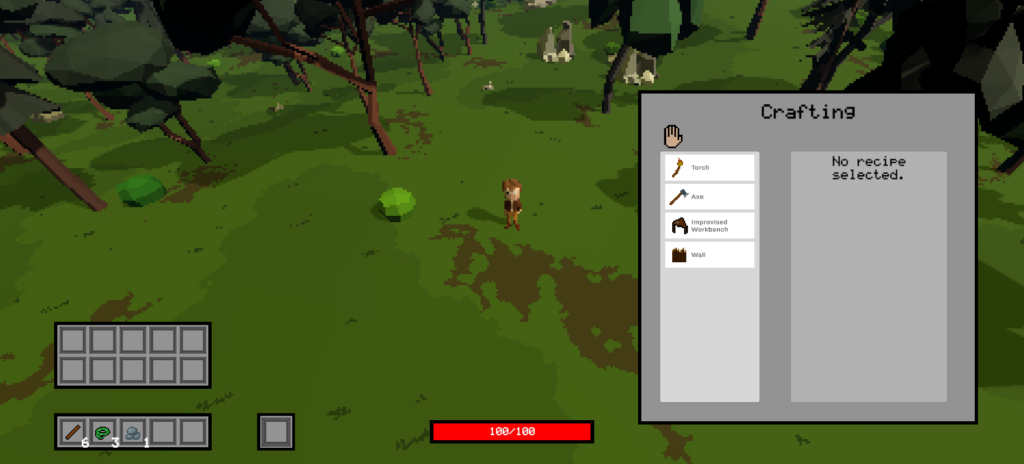
“Inftested forest” game interface
After the exam passed, the game was… ugly and boring. You could be entertained for about 20 mins, then you had nothing to do anymore, and you would just drop it. But I liked the base, and I always liked survivals in general, so I began to code my own, real survival.
In the summer of 2021, I started the project “Please, Enjoy your stay.” Little did I know that this was a colossal project. Looking at hours of Sebastian Lague’s procedural generation tutorial I finally managed to code and adapt a little the procedural world generation. Coding this project has always been in small bursts of code sessions that lasted some weeks, between pauses of months, while I was busy procrastinating University, burning neurons on some video games like League of Legends, and working at my new job as a software developer. By mid-2022, the game had a solid procedural generation… and nothing more. Not even a player. Around then, I had coded for 200 hours. Another year passed; I coded some smaller features – like a basic player and world spawning animation – and then I decided to create a classic roadmap with versions and features. I started by adding what was missing to my “game” to actually be a game, and I created the plan for version v0.0.1, which featured a very, VERY basic video game: a player who can move, die if they take damage (nothing could actually do damage but anyway-), day, night, a world with some biomes, and not much more.
Procedural world with free camera movement, before adding the player. By far my most liked video ever (posted on Twitter/X) in 2022, with more than 80 likes.
Procedural generation at work.
The v0.0.1 was the pilot version, completed on Nov 6, 2023, which contained the fundamental mechanics of the game. It featured very basic (but complex to code) mechanics:
- Procedural world generation with random seeds
- Forest, plains and sea biomes
- Trees, berry bushes
- Day/Night cycles
- Save and load worlds, objects
- Player spawn and respawn mechanic, death, eating, stamina, movement
- The first enemy, Goner – which could not spawn
- Basic crafting, the first improvised crafting table
- A basic version of an axe and picaxe – which you could not craft unless you cheated some starting materials
- Torches, a campfire
- A very basic version of a sword
- A few other things
Just getting to this point, with a “walking simulator” as a game, a basic enemy – which you couldn’t even find and fight – costed me an astonishing ~415 hours of work, mostly spent on coding the procedural generation and the save system.
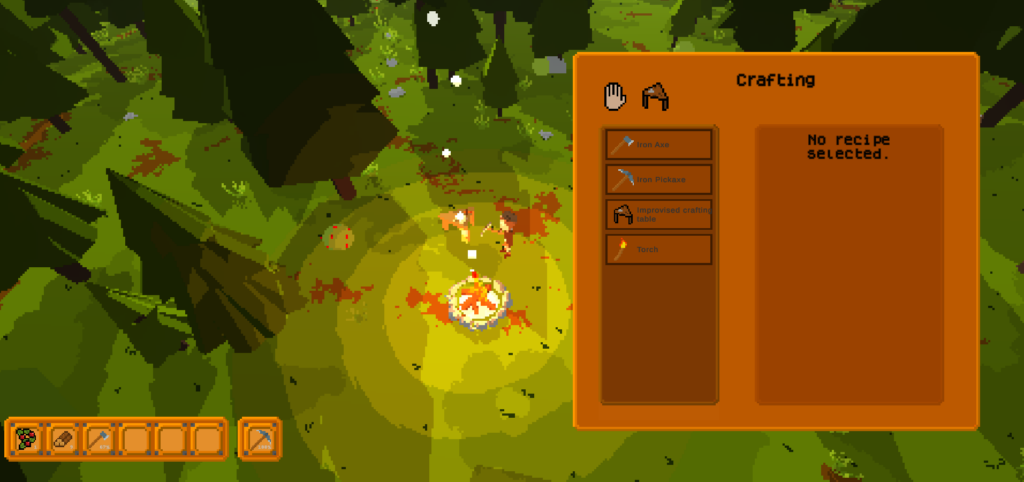
A player with the “tab” inventory open and the four basic craftings.
The first version was not published, for obvious reasons. The content was too low even for the lowest possible feedback; you could neither craft nor hit anything because you could not gather some basic materials. I created a Twitter account – which is now abandoned – and got my first few followers… probably all bots.
After that version, I took a pause of almost a year to focus on other things.
The player testing various sword items
Version v0.0.2 started some months later. See the next post for the new features added in v0.0.2!
Changelog:
V0.0.1 – “Genesis”
[First prototype version, worldgen and player]
[ADDED]
-Added basic procedural worldgen and world spawn animation. Basic menu and simple WASD player movement, run and jump. Added day and night cycle. Everything that’s in the game and is not mentioned in above versions has been done in this first version.